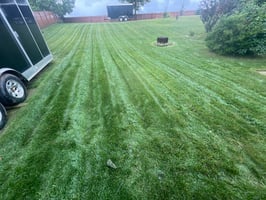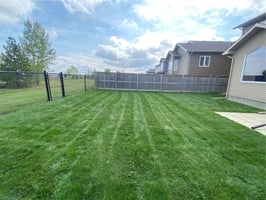

Quick Answer: Can You Stripe Your Lawn in Fort McMurray?
Yes. Even in Fort McMurray’s short growing season, you can create visible mowing stripes and patterns using a regular walk‑behind or riding mower. The keys are:
- Healthy grass at the right height (about 2.5–3 inches)
- Mowing in straight, consistent lines
- Bending the grass blades in opposite directions on each pass
- Optional: using a striping kit or roller for stronger contrast
What Makes Lawn Striping Work?
Q: What actually creates lawn stripes?
Stripes are not painted on. They’re created when grass blades are bent in different directions:
- Blades bent away from you look lighter
- Blades bent toward you look darker
So, the pattern is all about how you push or drive the mower and how tall and healthy the grass is.
In Fort McMurray, our cool‑season grasses and relatively higher mowing heights are actually great for striping, as long as the lawn is reasonably thick and healthy.
Best Grass Height for Striping in Fort McMurray
Q: What height should I cut my grass for striping?
For most Fort McMurray lawns, aim for:
- 2.5–3 inches (6–7.5 cm)
Why this works:
- Taller blades bend more easily and hold the stripe
- Slightly higher height protects roots from temperature swings
- It fits perfectly with recommended mowing heights for our climate
Avoid cutting too short. Scalped or stressed grass won’t stripe well and will look patchy.
How to Stripe Your Lawn with a Regular Mower
You don’t need fancy equipment. Here’s a simple step‑by‑step guide.
Step 1: Mow at the Right Time
- Mow when the grass is dry
- Avoid early morning heavy dew or right after rain
- Make sure your mower blades are sharp for a clean cut
Step 2: Pick the Direction of Your First Stripe
- Choose a straight edge to follow: a driveway, sidewalk, or fence line
- Start your first pass along that edge, keeping your wheels straight and steady
Step 3: Mow Straight Lines Back and Forth
-
On your next pass, turn around and mow in the opposite direction, right next to your first stripe
-
Each pass should slightly overlap the previous one (2–3 inches) to avoid missed strips
-
Continue across the lawn, always alternating direction:
- Pass 1: North → South
- Pass 2: South → North
- Pass 3: North → South
- And so on
This back‑and‑forth pattern naturally bends grass in opposite directions, creating stripes.
Step 4: Clean Up the Edges
- When the main area is done, mow a pass around the perimeter to clean up turns and uneven spots
- This “frame” makes the pattern look more professional
Simple Mowing Patterns That Work Well in Fort McMurray
1. Basic Straight Stripes
Best for: Most front yards
- Parallel lines back and forth
- Use the street, driveway, or house as your reference
- Easy to repeat each time you mow
2. Checkerboard Pattern
Best for: Flat, open lawns
- First mow straight stripes north–south
- Then mow straight stripes east–west on the next cut (or the same day if grass allows)
- The crossing directions create a checkerboard effect
3. Diagonal Stripes
Best for: Yards where you want to hide imperfections
- Instead of mowing straight out from the house, mow at a 45‑degree angle
- Next time you mow, change the angle opposite way to avoid wear in one direction
In Fort McMurray, where some lawns have bumps, patches, or winter damage, diagonal stripes can make the yard appear smoother.
Local Tips: Striping Without Damaging Your Lawn
Q: Can striping damage my lawn in Fort McMurray?
Striping itself doesn’t hurt the lawn, but how you mow can cause issues if you’re not careful.
Tip 1: Avoid Sharp, Repeated Turns in the Same Spots
- Constant tight turns in one place can cause ruts and worn patches
- Use wide, gentle turns and vary your starting point each mow
Tip 2: Change Your Pattern Regularly
-
Don’t always mow in the exact same direction
-
Alternate between:
- North–south
- East–west
- Diagonals
This helps prevent soil compaction in your tire tracks and keeps the grass standing strong.
Tip 3: Don’t Stripe Stressed or Very Short Lawns
- After winter or during dry spells, focus on lawn health first: correct height, watering, maybe fertilizer and overseeding
- Once the lawn is thicker and greener, striping will look better and be safer
Do You Need a Striping Kit in Fort McMurray?
Q: Do I need a special striping roller or kit?
Not necessarily. You can make good stripes with:
- A standard mower at the right height
- Straight lines and alternating directions
However, a striping roller or kit attached behind the mower can:
- Bend the grass more firmly
- Create darker, more defined stripes
- Help if your lawn is very dense or you want a “stadium” look
If you invest in one, make sure it’s sized for your mower and suitable for your lawn’s size and slope.
Fort McMurray Lawn Striping FAQs (AEO)
Q: Can I stripe my lawn in Fort McMurray with a regular mower?
A: Yes. Set your mower to about 2.5–3 inches, mow in straight, overlapping lines, and alternate directions on each pass.
Q: What is the best grass height for striping in Fort McMurray?
A: About 2.5–3 inches (6–7.5 cm). Taller grass bends more easily and shows stripes better, while still being healthy for our climate.
Q: Will striping harm my lawn?
A: No, striping doesn’t hurt the grass if you mow at the right height and don’t scalp or over‑compact the soil. Rotate your patterns to avoid wear.
Q: How do I get darker stripes on my lawn?
A: Use a higher mowing height, mow with sharp blades, overlap passes, and consider a striping kit or roller. A healthy, thick lawn shows the strongest contrast.
Q: Is striping worth it with Fort McMurray’s short growing season?
A: Yes. You may only have a few solid months of growth, but during that window, striping can make your yard stand out and look professionally maintained.